Any Question +91 90022 37890

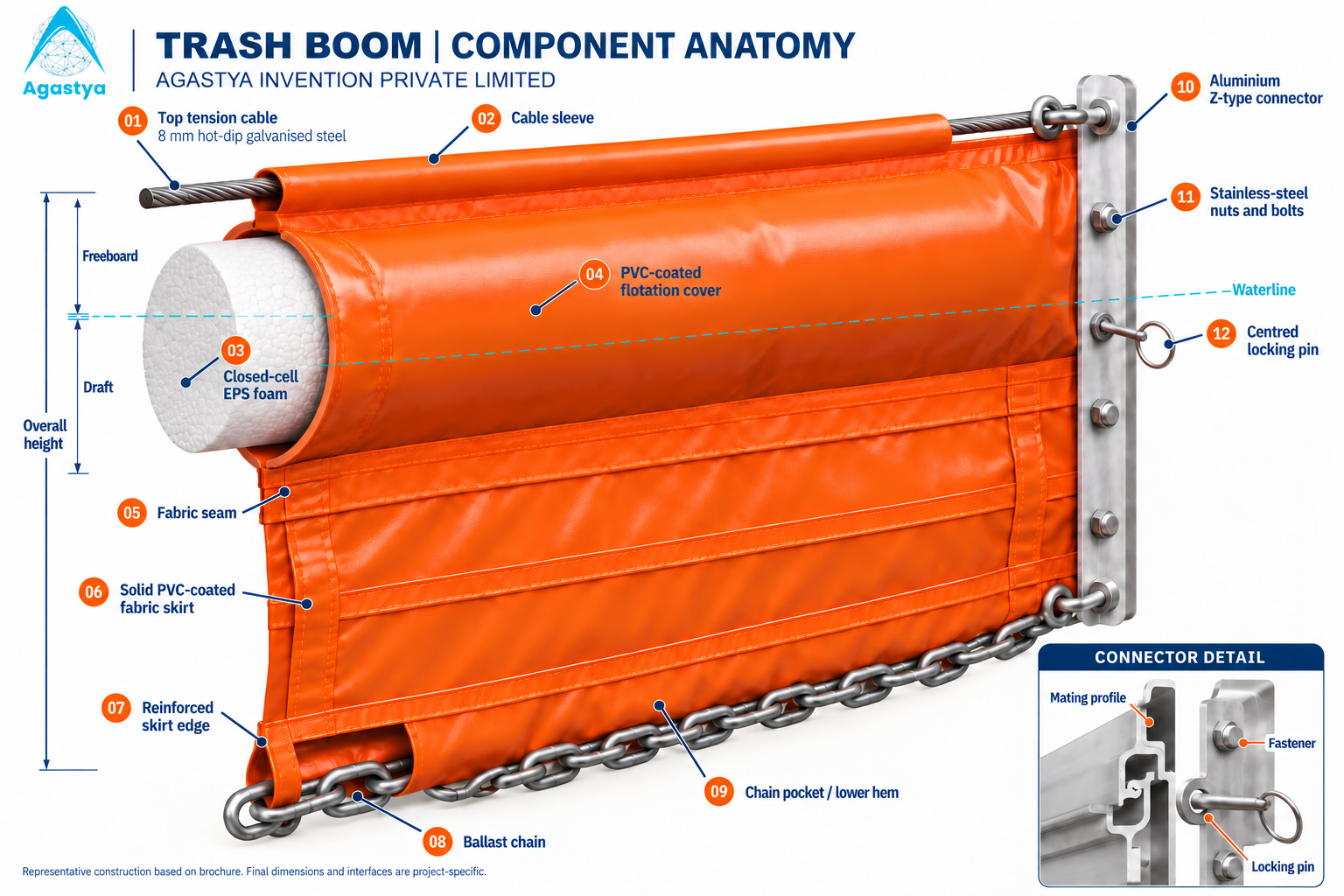
Trash Boom Explained: Components, Working Principle and Applications Floating waste is easier to manage when it can be intercepted at a defined location. Plastic bottles, packaging, vegetation and other waterborne debris can otherwise spread across a lake, travel along a drain or accumulate near sensitive infrastructure. A trash boom creates a floating barrier that helps intercept this material and guide it towards an accessible recovery point. Behind its simple appearance is a connected assembly of flotation, fabric, tension members, ballast, mechanical joints and restraint interfaces. Understanding these components helps explain how a trash boom functions—and why its configuration should suit the waterway. What Is a Trash Boom? A trash boom is a floating barrier designed to intercept, divert or concentrate floating solid debris. It typically combines a buoyant body at the water surface with a retention element extending below it. Connected boom sections form the required alignment, while an anchoring or termination arrangement holds the system in position. The Agastya configuration illustrated in this article uses an orange PVC-coated fabric body, closed-cell EPS flotation, a solid submerged skirt, a top tension cable, a lower ballast chain and aluminium section connectors. [Insert the labelled Agastya Trash Boom image here] Agastya Trash Boom component anatomy: a representative cutaway showing the flotation core, tension cable, solid fabric skirt, ballast chain and section connector. How Does a Trash Boom Work? The operating principle follows four stages: Approach: Floating debris moves towards the barrier with surface currents, runoff or wind-driven movement.Interception: The floating body and submerged retention element interrupt its onward movement.Diversion: A suitable boom alignment guides material along the barrier face.Collection: Waste concentrates at a planned location where it can be removed.The arrangement depends on the site. A boom may cross a defined channel, run at an angle towards a bank-side collection point or form a containment zone. The boom concentrates waste; a collection operation removes it. Both should be planned together. Trash Boom Components and Their Functions The numbered components below correspond to the annotated product image. 01. Top Tension Cable The top tension cable forms part of the structural load path through the boom assembly. It helps transfer forces along the connected system towards its designed restraint points. The cable, end terminations, section connections and anchoring interfaces must work together. Cable diameter alone does not define the capacity of the complete barrier. 02. Cable Sleeve The cable sleeve houses and positions the tension cable along the upper edge of the boom. It keeps the cable aligned with the fabric assembly and forms part of the interface between the flexible body and its tension member. Inspection should include wear, abrasion and damage around sleeve openings. 03. Closed-Cell EPS Foam The illustrated boom uses a closed-cell expanded polystyrene, or EPS, flotation core. The foam provides buoyancy to support the assembly at the water surface. The cutaway exposes the core to show how it sits inside the flotation cover. Float size and buoyancy reserve should be selected for the complete assembly and intended operating conditions. 04. PVC-Coated Flotation Cover The orange outer cover encloses the foam and forms the visible surface of the floating body. Fabric selection considers handling, sunlight exposure, abrasion and suitability for the intended water environment. Compatibility with industrial water conditions should be checked for the particular application. 05. Fabric Seams Seams connect the fabric panels, sleeves and reinforced areas into one assembly. These junctions are important inspection points. Local damage, separation or abrasion can affect the serviceability of the boom even when the surrounding fabric appears intact. 06. Solid PVC-Coated Fabric Skirt The skirt hangs beneath the flotation body and creates the submerged retention barrier. Its purpose is to help restrict floating material from moving beneath the boom. The appropriate depth depends on the debris and hydraulic conditions. A deeper skirt also presents more area to moving water. Draft should therefore be considered alongside current, accumulated debris and restraint loads. 07. Reinforced Skirt Edge Reinforced edges support selected boundaries and connection areas of the fabric assembly. These details help accommodate handling and local attachment demands. Their condition should be checked, particularly where the flexible fabric meets rigid hardware. 08. Ballast Chain The lower ballast chain adds weight to help the skirt hang beneath the float and maintain its intended submerged profile. It performs a different function from the anchoring system. Ballast supports the skirt arrangement; anchors or termination interfaces restrain the boom’s position. 09. Chain Pocket or Lower Hem The lower hem accommodates or retains the ballast chain, depending on the construction. The cutaway in the image shows the relationship between the chain and its fabric housing. This area should be inspected for abrasion, snagging and damage caused by contact with debris or nearby surfaces. 10. Aluminium Z-Type Connector The illustrated aluminium connector provides the interface between adjacent boom sections. Modular connections support transportation, assembly, maintenance and replacement of individual lengths. Connector profiles must be compatible and correctly engaged. 11. Stainless-Steel Nuts and Bolts Fasteners secure the connector assembly to its attachment area. Inspection should check for loose or missing hardware, wear and deterioration around the fastening points. Replacement hardware should follow the approved project specification. 12. Centred Locking Pin The removable locking pin retains the mating connector assembly. It should be correctly seated and secured during installation. Its condition and retention should remain part of routine connection checks. Understanding Freeboard, Draft and Overall Height Three terms describe the boom’s vertical arrangement: TermMeaningFreeboardThe height of the boom above the operating waterlineDraftThe depth of the boom below the operating waterlineOverall heightThe combined freeboard and draftThese dimensions influence how the barrier interacts with floating debris and moving water. The annotated image explains the terminology. It represents a construction concept rather than a dimensioned manufacturing drawing. Where Can Trash Booms Be Used? Trash booms can be considered for several waterway environments, subject to site assessment. Lakes and Urban Water Bodies A defined barrier can help concentrate floating litter or vegetation in areas with practical collection access. Wind direction and seasonal water-level changes influence the arrangement. Drains and Channels A boom can guide floating solids towards an accessible removal point. Flow variability, storm conditions and the consequences of debris accumulation require particular attention. Industrial Waterways Floating-debris interception may support housekeeping and recovery operations in suitable industrial channels. Fabric and hardware compatibility should be checked against actual water conditions. Power-Sector Waterways Trash booms may form part of a floating-debris management arrangement around power-sector water bodies. Selection should consider hydraulic conditions, operating access and the consequences of blockage or accumulation. Why Anchoring and Water-Level Movement Matter The restraint arrangement must hold the boom against the selected loads while allowing the movement required by changing water levels. Depending on the location, interfaces may include bank terminations, bed anchors or a guided sliding arrangement at a wall or structure. A suitable interface should accommodate the intended operating range without unnecessarily pulling the flotation body beneath the surface. Restraint geometry and component capacity require project-specific engineering. Planning Waste Collection and Maintenance A trash boom works within a wider recovery operation. Before installation, establish: Where intercepted waste will collect.How people or equipment will reach it.How accumulated material will be removed.Who will inspect and maintain the system.How recovered waste will be handled and transferred.Routine inspections should cover flotation, fabric, seams, cables, ballast, connectors and restraint points. Additional checks may be needed after significant weather, unusual loading or changes in water conditions. A simple photographic inspection record can help identify developing damage and support timely maintenance. What Information Is Needed to Select a Trash Boom? A useful project brief includes: Site location and waterway type.Approximate span and proposed barrier alignment.Normal and seasonal water levels.Available information on current and flow direction.Debris type and expected accumulation.Bank, wall or bed conditions at restraint locations.Collection access and proposed removal method.Photographs of the waterway and fixing areas.These inputs help establish the appropriate flotation, skirt depth, section lengths, connections and restraint arrangement. Frequently Asked Questions Does a trash boom remove waste automatically? A conventional trash boom intercepts and concentrates floating material. Removal requires a planned manual or mechanical collection operation unless a separate recovery system is included. Can a trash boom remove dissolved pollution? Trash booms address floating solid debris. They do not treat dissolved contaminants or replace a water-treatment process. Is a deeper skirt always better? The appropriate depth depends on the application. Increasing skirt depth also increases the area exposed to moving water, so retention requirements and hydraulic loads must be assessed together. Can the same boom be used at every site? Different waterways have different debris, currents, level variations and restraint conditions. The configuration should be selected for the intended site. Are trash boom sections replaceable? A modular arrangement allows individual sections to be disconnected for maintenance or replacement, provided the operation follows the approved handling and installation procedure. What is the difference between ballast and anchoring? Ballast helps the skirt maintain its submerged profile. Anchoring and termination interfaces restrain the position of the boom system. Discuss Your Trash Boom Requirement with Agastya Agastya Invention Private Limited provides site-specific floating barrier solutions for intercepting, diverting and concentrating waterborne debris. Share your site photographs, approximate span, debris information, water-level range and recovery arrangements to begin the project discussion. Visit www.agastya.in to discuss your waterway protection requirements. The illustrated assembly is representative. Final materials, dimensions, connections, anchoring and operating limits depend on the agreed project specification.